If you’ve been practicing for more than a few years, you’ve had this conversation with yourself a hundred times: Zirconia vs PFM Crowns: 5 Honest Facts? It’s one of those decisions that feels simple until you’re staring at a prep, thinking about the patient’s bite, their budget, and how visible that tooth is when they smile.
This isn’t going to be a textbook comparison. It’s a straightforward, practical look at Zirconia vs PFM Crowns – what each one actually does well, where each one falls short, and how to think about the choice for your next patient.
Table of Contents
1. Quick Answer - Which One Wins?
Honestly? Neither wins outright. The zirconia vs PFM crowns debate isn’t about one material being universally better – it’s about matching the right material to the right tooth and the right patient.
That said, here’s the short version: zirconia tends to be stronger, more biocompatible, and increasingly the go-to for both front and back teeth thanks to newer translucent versions. PFM still holds its own, especially for long-span bridges, tight occlusal clearance cases, and budget-conscious patients. Keep reading for the full picture.
2. What Are PFM Crowns, Really?
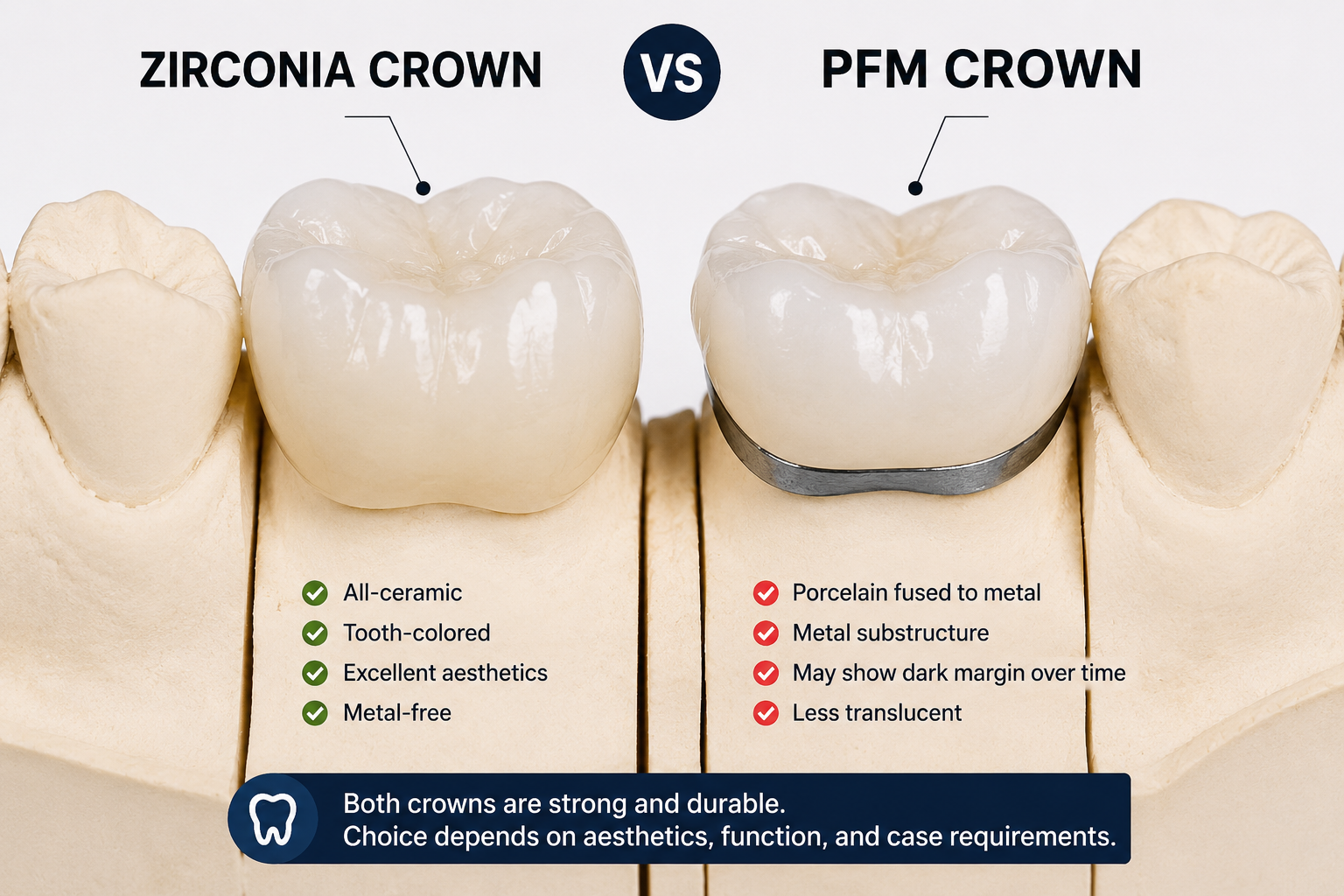
A PFM crown – porcelain-fused-to-metal – is exactly what it sounds like. A metal substructure forms the core, and porcelain is layered over it to mimic the look of a natural tooth. It’s been around since the 1950s, and for good reason: it works.
The metal core gives PFM crowns real strength, while the porcelain layer handles the aesthetics. It’s a tried-and-tested combination that dentists have leaned on for decades, especially before zirconia became widely available.
But the design isn’t perfect. Over time, the bond between porcelain and metal can weaken, and chipping is a known issue – studies show porcelain chipping occurs in roughly 5 to 10 percent of PFM cases over a decade. When that happens, the grey metal underneath can peek through, which is never a fun conversation to have with a patient.
3. What Are Zirconia Crowns, Really?
A zirconia crown is milled from a solid block of zirconium dioxide – a ceramic material known for being exceptionally strong. Unlike PFM, there’s no metal involved at all, which makes zirconia naturally more gum-friendly for patients sensitive to metal.
Early zirconia crowns had a reputation for looking a bit chalky or opaque – fine for back teeth, not ideal for a front tooth smile. That’s changed. Newer translucent and layered zirconia options now offer shade matching and lifelike depth that rivals – and in many cases beats – what PFM can deliver.
Zirconia also plays well with digital workflows. If your dental laboratory uses CAD/CAM milling, zirconia crowns can often be designed and produced faster and with more consistency than traditional PFM layering.
4. Strength & Durability - Head to Head
This is where the zirconia vs PFM crowns comparison gets interesting. Numbers help here more than opinions do.
Factor
Flexural strength
Common failure mode
5-year survival rate
Best for bruxism / heavy bite
Wear on opposing teeth
PFM Crowns
~120 MPa (Porcelain layer)
Porcelain chipping at the veneer
Mid-90% range
Workable, but at higher risk
Moderate
Zirconia Crowns
~900–1400 MPa (full-contour)
Rare bulk fracture (uncommon)
Often above 95%
Strongly preferred
Low, if properly polished
For patients who grind or clench their teeth, zirconia is generally the safer bet. It resists fracture far better than the porcelain layer on a PFM crown – though it does need careful polishing, since unpolished zirconia can wear down opposing natural teeth faster than you’d like.
5. Aesthetics - Which Looks More Natural?
PFM crowns have historically been considered the gold standard for front-tooth aesthetics, and when layered by a skilled dental laboratory technician, they can still look excellent. The trade-off is that opaque metal core underneath – it limits how much light passes through the crown, which can affect how lifelike it looks under certain lighting.
Zirconia has closed this gap significantly. With layered and multi-shaded zirconia now standard at most modern labs, many clinicians now prefer it even in the smile zone. There’s also a bonus: zirconia naturally resists staining from tea, coffee, and tobacco, something porcelain doesn’t always do as well over the years.
If a patient has a high smile line and you’re chasing maximum translucency, layered zirconia is usually your best shot. For patients who simply want a solid, reliable crown without obsessing over every shade nuance, both materials will serve them well.
6. Cost, Prep, and Lab Turnaround
Budget matters, and it’s worth being upfront about it with patients. PFM crowns are generally more affordable, which makes them a practical choice for cost-conscious patients or cases where the tooth isn’t highly visible.
Zirconia crowns usually cost more upfront, but many dentists find that the lower remake rate – fewer chips, fewer fractures – balances that out over time. Less chair time spent on repairs is worth something too.
- Tooth preparation: PFM typically requires slightly more reduction to accommodate both the metal and porcelain layers. Zirconia, especially monolithic designs, often allows for more conservative prep.
- Lab turnaround: A digitally-equipped dental laboratory can often mill and deliver zirconia crowns faster than the multi-step layering process PFM requires.
- Tight occlusal clearance: In cases with very limited vertical space – like some implant-supported restorations – PFM can sometimes still be the more practical choice.
7. Which Crown Suits Which Patient?
Here’s a simple way to think it through, case by case:
- Front tooth, high smile line: Layered zirconia usually wins on aesthetics, though a skillfully layered PFM can still work in the right hands.
- Back tooth, heavy chewing forces: Zirconia is the stronger, more predictable choice – especially for molars taking the brunt of daily bite force.
- Patient grinds or clenches (bruxism): Zirconia, without much debate. The fracture resistance matters a lot here.
- Metal sensitivity or gum concerns: Zirconia is metal-free and generally easier on soft tissue.
- Budget-conscious patient, lower-visibility tooth: PFM remains a perfectly reasonable, time-tested option.
- Long-span bridge or tight clearance case: PFM can still have an edge here, depending on the specific clinical situation.
In many full-mouth cases, dentists actually mix both materials – PFM for long bridges, zirconia for single posterior crowns – and let one dental laboratory handle the whole case so the shade and contour stay consistent across materials.
To Wrap Up
There’s no universal winner in the zirconia vs PFM crowns debate, and honestly, that’s a good thing. It means you get to make the call based on what’s actually in front of you – the tooth, the bite, the patient’s habits, and their budget – rather than defaulting to one material out of habit.
What matters more than the material itself is the quality of the lab work behind it. A well-made PFM crown from a skilled dental laboratory can outperform a poorly milled zirconia crown, and vice versa. The lab relationship is just as important as the material decision.
Not sure which material is right for an upcoming case? Talk to the team at CornerStone Dental Laboratory – we work with both zirconia and PFM every day and are happy to walk through the specifics with you.
Are zirconia crowns better than PFM crowns?
Not always – it depends on the case. Zirconia is generally stronger and more biocompatible, while PFM still works well for certain bridges and budget-conscious cases. The right choice depends on the tooth, the bite, and the patient.
Do zirconia crowns look more natural than PFM crowns?
Not always – it depends on the case. Zirconia is generally stronger and more biocompatible, while PFM still works well for certain bridges and budget-conscious cases. The right choice depends on the tooth, the bite, and the patient.
Which crown lasts longer, zirconia or PFM?
Zirconia crowns typically have a slightly higher 5-year survival rate and are less prone to chipping. PFM crowns can chip at the porcelain layer over time, especially under heavy biting forces.
Are zirconia crowns more expensive than PFM crowns?
Usually, yes – zirconia costs a bit more upfront. But many dentists find it pays off through fewer remakes and repairs down the line.
Can zirconia crowns be used for front teeth?
Yes. Layered, translucent zirconia is now a popular choice for front teeth and can match natural tooth shade very well, especially for patients with high smile lines.
Is PFM still a good option in 2026?
Yes, especially for long-span bridges, tight occlusal clearance cases, or patients on a tighter budget. It’s a time-tested material that still performs reliably when done well.
Which crown is better for patients who grind their teeth (bruxism)?
Zirconia is generally the safer choice for bruxism patients because of its higher fracture resistance compared to the porcelain layer on a PFM crown.
Does the dental laboratory affect how well a crown turns out?
Absolutely. A skilled dental laboratory team affects fit, shade accuracy, and finish regardless of material. A well-made PFM crown can outperform a poorly milled zirconia crown, so the lab matters as much as the material.