Digital Dentistry in India is transforming how crowns, bridges, and other dental restorations are designed and manufactured. Not too long ago, getting a crown made meant taking a conventional impression (hoping the patient didn’t gag), sending a physical model to a dental lab in India, and waiting a week or more for the result-sometimes only to find the fit was off and the process had to be repeated.
That process isn’t dead yet, but Digital Dentistry in India is changing it faster than most dentists realise. CAD/CAM technology-computer-aided design and computer-aided manufacturing – is at the centre of this shift. If you haven’t fully explored what it means for how you work with your dental lab, this guide is for you.
We’ll walk through exactly how Digital Dentistry in India is reshaping dental labs, what the technology actually does, and why it matters for the quality and efficiency of your everyday restorative cases.
Table of Contents
1. So, What Exactly Is Digital Dentistry?
Digital dentistry is a broad term that covers any dental technology using digital or computer-based tools in place of traditional mechanical or analogue processes. Think: intraoral scanners instead of impression trays, CAD software instead of wax carving, and milling machines or 3D printers instead of hand-layered ceramics.
Within the context of digital dental labs, the two most important technologies are:
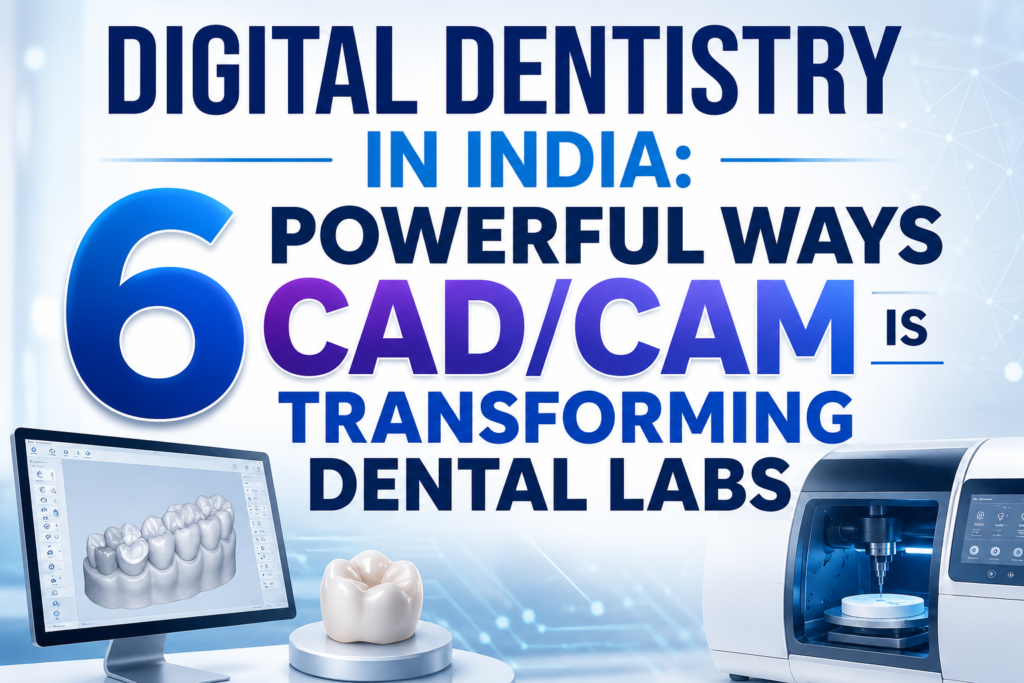
- CAD – Computer-Aided Design: A technician uses software to digitally design a crown, bridge, denture, or other restoration in 3D. The design can be precisely adjusted, shade-mapped, and checked for fit – all before any physical material is touched.
- CAM – Computer-Aided Manufacturing: Once the digital design is finalized, a milling machine carves the restoration from a block of zirconia, ceramic, PMMA, or wax. Or, alternatively, a 3D printer builds it layer by layer.
Together, CAD/CAM technology in dental labs replaces the longest and most error-prone steps of the traditional workflow – making restorations faster, more consistent, and more precise.
2. Why Indian Dental Labs Are Going Digital - Right Now
India’s dental market is growing – and digital dentistry in India is growing with it. The numbers paint a clear picture:
₹548 Cr | Estimated size of India’s dental CAD/CAM market in 2024 (~$66 million USD) |
7.6% CAGR | Projected annual growth rate of India’s dental CAD/CAM market through 2035 |
₹1,230 Cr | Projected market value by 2035 (~$148 million USD) as digital adoption deepens |
2x faster | Typical turnaround time reduction when a dental lab shifts to CAD/CAM workflows |
As eHealth Magazine India reports, clinics and dental labs across India are now moving from isolated digital purchases to end-to-end connected workflows that link the chair and the lab. It’s no longer a niche investment – it’s fast becoming the baseline.
3. Six Ways CAD/CAM Technology Is Changing Dental Labs
1 - Impressions Are Becoming Optional
With intraoral scanners now widely available, dentists can send a digital file directly to the dental lab instead of a physical impression. No more distortion from impression material pulling away from the tray. No more stone model cracking in transit. The digital scan arrives instantly and the dental lab can start designing straightaway.
2 - Restorations Are More Consistent
Hand-layering ceramics is an art – and like all art, it varies between technicians and between days. CAD/CAM milling in a digital dental lab removes a lot of that variability. The milling machine follows the digital design precisely, every time. That means more consistent marginal fit, more predictable occlusion, and fewer surprises when you seat the restoration.
A PubMed study on CAD/CAM use among Indian dental professionals found that clinicians who worked with digital dental labs reported meaningfully better fit consistency compared to traditional lab workflows.
3 - Turnaround Times Are Shrinking
A traditional PFM crown might take 7 to 10 days from impression to delivery. A CAD/CAM crown from a well-equipped dental lab in Bangalore can often be done in 3 to 4 days – sometimes faster. For urgent cases or patients who travel from out of town, that difference genuinely matters.
This is one of the clearest practical wins of digital dentistry in India for busy dental practices: less waiting means happier patients and fewer gaps in your schedule.
4 - DMLS Is Handling What Milling Can't
Not everything can be milled. For complex metal frameworks, surgical guides, and implant-supported structures, DMLS – Direct Metal Laser Sintering – steps in. It’s a form of 3D printing that fuses metal powder layer by layer using a laser, producing structures with incredibly precise geometry that would be difficult or impossible to cast or mill.
At CornerStone Dental Laboratory, our DMLS capability means we handle complex implant and full-arch cases digitally from start to finish — which keeps case timelines shorter and quality higher.
5 - Aesthetics Are Easier to Get Right
Shade matching has historically been one of the trickiest parts of crown and veneer work – a lot depends on the lighting in your clinic and the skill of whoever’s matching the shade. Digital shade-taking tools and spectrophotometers used by modern digital dental labs take the guesswork out of it.
Combined with multi-layered translucent zirconia that can be digitally designed to match the shade gradient of neighbouring teeth, the aesthetic results from a CAD/CAM dental lab are now genuinely competitive with the best hand-layered ceramics – and far more reproducible.
6 - Communication Between Clinic and Lab Is Better
This one doesn’t get talked about enough. Digital dentistry in India has made it much easier for dentists and dental labs to communicate. You can share a digital file, annotate a design, approve a virtual try-in, and flag a concern – all before anything physical is made. Fewer misunderstandings. Fewer remakes. More confidence on both sides.
The best digital dental labs use this communication advantage actively – reaching out proactively when they spot something in the design that might cause a problem clinically. That kind of collaboration simply wasn’t possible with physical impressions and handwritten prescriptions.
4. How a Digital Dental Lab Workflow Actually Looks
For dentists who haven’t worked with a digital dental lab before, here’s what the process looks like from your end:
- You take a digital impression using an intraoral scanner in your clinic, or send a physical impression if you don’t have one yet.
- The digital file lands at the dental lab instantly – or the physical impression is scanned on arrival.
- A technician designs the restoration in CAD software, working from your prescription. Some labs will send you a digital preview for approval before milling.
- The milling machine or DMLS printer fabricates it from the approved design – zirconia, ceramic, metal, or PMMA depending on the case.
- Finishing and QC happen at the lab – shade checks, surface polish, marginal fit inspection.
- Delivery to your clinic – usually within 3 to 5 working days for standard cases.
The whole thing is more transparent than a traditional workflow, and far less dependent on things going right at every physical handoff point.
5. Chairside Milling vs. Centralised Digital Dental Lab - Which Makes More Sense?
A question a lot of dentists ask: should I invest in my own chairside CAD/CAM milling machine, or just work with a digital dental lab in India? Honest answer – it depends on your case mix and practice size.
Factor | Chairside Milling | Digital Dental Lab |
Initial cost | High (equipment + training) | Low (no capital investment) |
Case complexity | Single unit crowns, inlays, onlays | Any – from veneers to full arches |
Aesthetic quality | Good for simple cases | Better for complex multi-unit work |
Turnaround | Same-day possible | 3–5 working days typically |
Material range | Limited to clinic’s milling blocks | Full range – zirconia, DMLS, ceramic |
DMLS / implant cases | Not possible chairside | Fully supported |
Best for | High-volume single-unit practices | Mixed or complex case practices |
For most dental practices in India, partnering with a well-equipped digital dental lab makes more financial sense than investing in chairside equipment – especially when the lab handles complex cases and implant work that a chairside mill simply can’t do.
6. What This All Means for Your Practice
Let’s bring this back to something practical. If you’re a dentist in India working with a traditional dental lab, here’s what switching to or partnering with a digital dental lab actually looks like day to day:
- Fewer remakes: Digital workflows remove the single biggest cause of remakes – distorted impressions. When the geometry is accurate from the start, the crown fits better the first time.
- Less chair time per case: No need to seat a patient for a second appointment just to re-do an impression or adjust a misfitting crown.
- Faster case completion: CAD/CAM dental lab turnarounds in India are consistently faster than traditional timelines, which means happier patients and more cases closed per month.
- Confidence in complex cases: Whether it’s a full-arch implant case or a multi-unit aesthetic zone restoration, a digital dental lab gives you a reliable, skilled partner who can handle the complexity digitally.
- Better patient communication: Digital previews, shade simulations, and smile design tools from a modern dental lab make it easier to show patients what they’ll get – improving case acceptance.
Real Talk: What to Expect When You Start Working with a Digital Dental Lab
If you’ve been used to sending physical impressions, the first time you send a digital scan can feel a bit odd – like something’s missing. It’s also worth knowing that digital dentistry in India is still at different stages of adoption across cities and clinics, so the quality you get depends heavily on which digital dental lab you choose.
A few things to keep in mind:
- Ask about their software and equipment: A good digital dental lab will be happy to tell you what CAD software and milling machines they use. Exocad, 3Shape, Roland, and Wieland are reliable names to know.
- Don’t expect perfection from day one: Like any clinical workflow change, there’s a short adjustment period. Prescriptions may need small tweaks. Communication styles need aligning. Give it 3 to 5 cases before judging the relationship.
- Intraoral scanner? Not mandatory: If you don’t have one yet, most digital dental labs in India can scan your physical impressions on arrival. You still get most of the digital workflow benefits without the scanner investment.
To Wrap Up
Digital dentistry in India isn’t a distant trend anymore. It’s happening right now, in dental labs across Bangalore, Mumbai, Chennai, and every major city in between. CAD/CAM technology is making restorations more precise, more consistent, and faster to deliver – and the dentists who are already working with digital dental labs are seeing that directly in their clinical outcomes and patient satisfaction.
You don’t need to overhaul your entire workflow overnight. Start with one or two cases, see how the digital dental lab process feels, and go from there. The shift is worth making – and the sooner you make it, the more you’ll wonder why you waited.
What is digital dentistry and how does it affect dental labs?
Digital dentistry refers to using digital tools – like intraoral scanners, CAD software, and milling machines – instead of traditional manual processes. For dental labs, it means faster production, more consistent restorations, and better communication with the dentist. Instead of working from a physical impression, a digital dental lab receives a scan file and designs the restoration on-screen before milling or printing it.
What does CAD/CAM stand for in dentistry?
CAD stands for Computer-Aided Design and CAM stands for Computer-Aided Manufacturing. In a dental lab, CAD software is used to digitally design a crown, bridge, or other restoration. The CAM part — a milling machine or 3D printer — then fabricates it from the approved digital design. Together, they replace much of the handwork that traditional dental lab workflows depend on.
Is digital dentistry available in India right now?
Yes, and it’s growing fast. India’s dental CAD/CAM market was valued at around ₹548 crore (~$66 million USD) in 2024 and is projected to nearly double by 2035. Dental labs in cities like Bangalore, Mumbai, Chennai, and Hyderabad are already fully digital — offering CAD/CAM milling, DMLS printing, and intraoral scan integration to dentists across India.
Do I need an intraoral scanner to work with a digital dental lab?
No. Most digital dental labs in India – including CornerStone – can scan your physical impression on arrival and convert it into a digital file. You still get most of the benefits of a digital workflow without needing to invest in an intraoral scanner right away. That said, sending a digital scan directly does give you the fastest turnaround.
How much faster is a CAD/CAM dental lab compared to a traditional lab?
In most cases, yes — and sometimes better. CAD/CAM milled zirconia crowns have exceptional strength (up to 1,400 MPa in full-contour form), and modern translucent zirconia options now rival the aesthetics of hand-layered ceramics. The key difference is consistency: a milled crown is far less variable than one made entirely by hand.
Are CAD/CAM crowns as strong and aesthetic as hand-made ones?
DMLS stands for Direct Metal Laser Sintering. It’s a 3D printing process that fuses metal powder layer by layer using a laser. Dental labs use DMLS for complex metal frameworks, surgical guides, and implant-supported structures — cases where the geometry is too intricate to mill or cast accurately. It’s especially useful for full-arch implant cases.
What is DMLS and when does a dental lab use it?
Digital dentistry refers to using digital tools – like intraoral scanners, CAD software, and milling machines – instead of traditional manual processes. For dental labs, it means faster production, more consistent restorations, and better communication with the dentist. Instead of working from a physical impression, a digital dental lab receives a scan file and designs the restoration on-screen before milling or printing it.
Can a digital dental lab handle full-mouth rehabilitation cases?
Yes – and they’re often better equipped for it than traditional labs. A digital dental lab can design and produce all the components of a full-mouth rehab – including zirconia crowns, implant prosthetics, and DMLS frameworks – within a single connected digital workflow. This keeps shade, contour, and occlusion consistent across the entire case.